
You’ve lost weight before. Maybe twenty pounds on a strict diet and a lot of early mornings on the treadmill. It came off, and you looked about the same, just smaller. Then a busy quarter, a run of client dinners and a week at the beach brought most of it back.
Now you’re looking for a personal trainer for weight loss, and you’d like this to be the last time you do this.
The short answer: what works is strength training plus coached nutrition, not more cardio. Lifting holds on to the muscle that makes you look lean once the fat comes off. Nutrition sets the pace. A coach keeps both adjusting as your body and your week change, and that’s the part that falls apart when you go it alone. If you’ve lost the same weight more than once, apply for coaching and tell us how the last attempt ended. Your first session with us is a complimentary strategy session.
Key points
- Dieting alone takes some muscle along with the fat. In a 2026 review of 34 trials, adding exercise to a calorie deficit prevented nearly half of that loss.
- Cardio burns calories while you do it. Strength training changes what your body looks like when the weight is gone.
- The scale stalls for predictable reasons, and most of them are fixed by adjusting the plan, not by trying harder.
- A good trainer for weight loss earns their keep on nutrition and consistency, not just the workouts.
Why does weight loss stall when you do it alone?
Eat less than you burn and your body pulls energy from storage. Most of it comes from fat. Some of it comes from lean tissue, the part of you that isn’t fat, muscle included. Lose enough muscle and you end up lighter but softer, with less of the tissue that gives you shape and strength.
Then the body pushes back. In our experience, hunger tends to climb as a diet drags on, and people move a little less during the day without noticing. The deficit you started with quietly shrinks. The scale stops, and most people respond by cutting harder or running more, which makes the hunger worse.
And the plan was written for a perfect week. Yours has a flight on Tuesday, a dinner on Thursday and kids’ games all Saturday. A plan that can’t bend around that week breaks.
What does the research say about lifting while you lose weight?
A 2026 meta-analysis by Deller and colleagues pulled together 34 randomized trials with 1,455 adults who were overweight or had obesity. Everyone cut calories. Some also trained.
The people who added exercise kept on average 0.87 kilograms more fat-free mass than the people who only dieted. That’s nearly half of the loss prevented, 45.7 percent by the authors’ math. Strength training on its own clearly helped, about 0.83 kilograms. Endurance training on its own fell just short of statistical significance. The authors didn’t find a significant difference between training types, but the estimates leaned toward plans that included lifting, and mixing strength and endurance work did the most.
Two takeaways, the way we read it. Training while you diet protects muscle, and lifting looks like the strongest single piece of that. And conditioning still has a job. That’s not an argument for cardio as punishment. It’s an argument for a plan where both are placed on purpose.
Why isn’t more cardio the answer?
An hour on the bike to “burn off” last night’s dinner feels productive. It’s also the slowest way we know to change how you look. You can’t out-run a plan that isn’t working, and in our experience long, hard cardio sessions tend to leave people hungrier, not leaner.
Cardio does real work. It builds your engine, helps you recover between sets and makes the stairs at the office easier. We program it. We just don’t use it to pay for meals.
What should a personal trainer for weight loss actually do?
Here’s how we’d set it up. The details change from person to person.
- Watch you move before loading anything. Squat, hinge, push, pull, carry. Old injuries, stiff hips, a shoulder that talks. Nobody can watch their own squat from the side mid-rep, and a fat-loss plan that ignores a cranky hip rarely lasts.
- Make the lifting progressive. More weight, more reps or more control, week after week. Getting the amount right is where most people go wrong. Too easy and your body has no reason to keep its muscle. Too much while you’re eating less and you stall, get sore for days or something flares.
- Set targets you can hit on a real Tuesday. Calories and macros that account for the client dinner and the airport, with enough protein to hold on to muscle. Then the targets move as your weight, training and appetite change. Most people set a number once and never touch it again.
- Measure more than the scale. Strength, waist, photos, how your clothes fit. The scale bounces with water and salt. Reading it wrong is how good plans get abandoned in week three.
- Plan for the weeks that break plans. Travel, a trial, quarter-end, the holidays. A coach who’s thought about those weeks has a version of the plan ready for them.
- Know when to push and when to hold. Some weeks the right move is a harder deficit. Some weeks it’s holding steady so you can sleep and train well.
You could find every one of these ideas online. An app can count your calories. It can’t see that you’re under-eating protein on travel days, or that your squat has gotten shallower as the weight went up.
From the floor: In our experience, people who come to us for weight loss rarely lack willpower. Most have already proved they can diet hard. What they haven’t had is a plan that keeps the muscle, changes the food when progress slows, and survives a bad month without starting over.
If you’re tired of losing the same weight every year, apply for coaching and tell us what your week really looks like.
Why weight loss sticks with a coach
The hard part isn’t knowing that you should lift and eat well. It’s getting the load, the food and the timing right, for months, while your weight, your appetite and your calendar keep changing, with someone who sees what you can’t.
That’s what we do all day. At Gryffon Performance we don’t stop at lighter. The goal is a lean, balanced body, and personalized nutrition coaching, calories and macros included, comes with every training program.
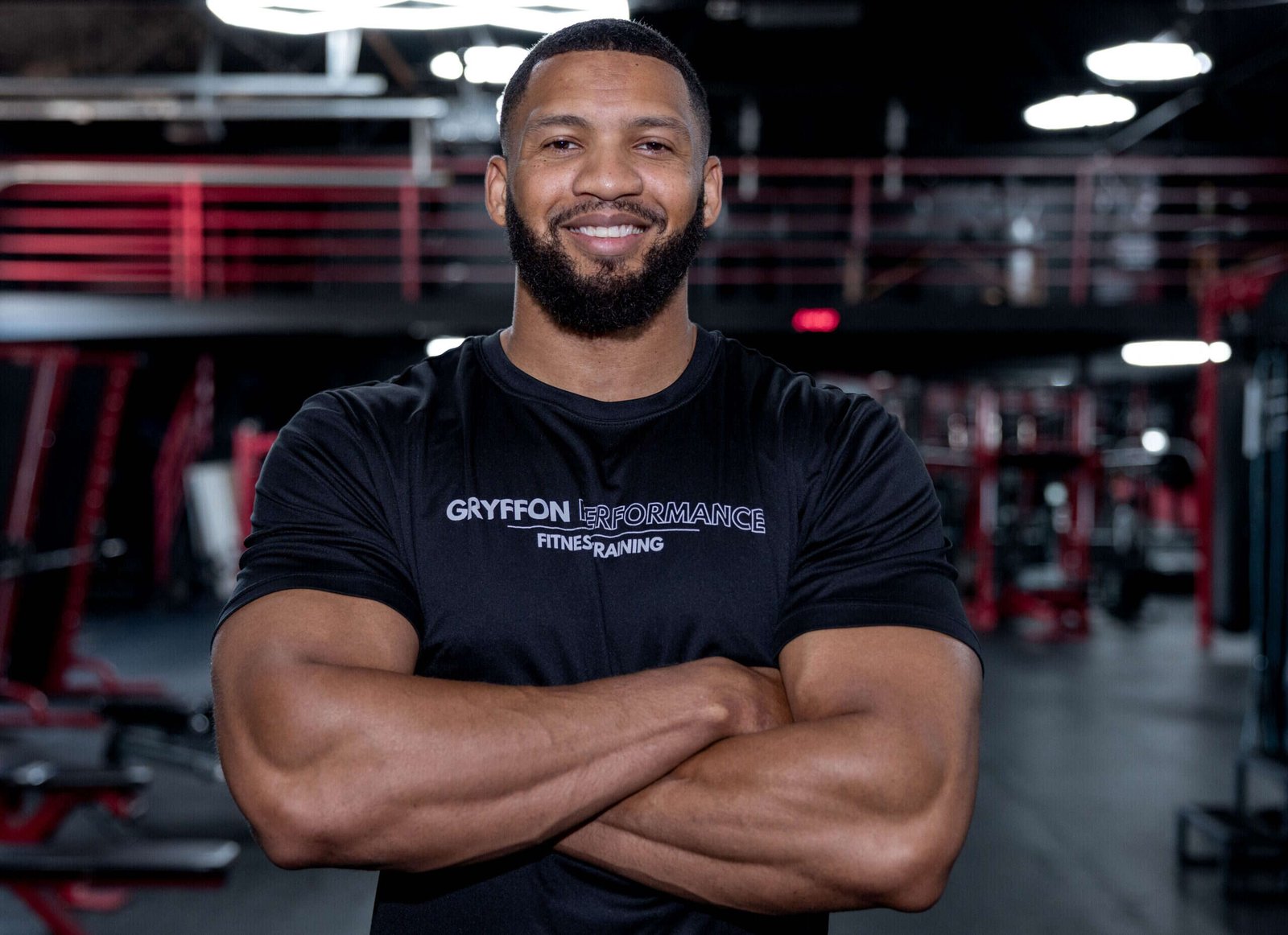
Everything begins with a complimentary strategy session: one hour, face to face, with David, our founder and head coach, who has coached men and women for more than 15 years. You’ll talk through your goals, what you’ve tried, your training history, your schedule and anything that hurts. Then comes a physical assessment, a conversation about how you eat now and a tour of the studio. By the end you’ll have a starting point, a schedule that fits the week you actually have and a plan that makes sense to you.
Worried an old injury will get in the way, or not sure where to begin? Plenty of people feel that way, and it shouldn’t hold you up. David looks at how you move in person, and if something needs more than training, he knows the right doctors to send you to.
Personal training for weight loss in Dallas
Gryffon Performance is a private training studio at 1925 E Levee St, Dallas, TX 75207, in the Dallas Design District, with free parking. We’re about 12 minutes from Highland Park and close to Uptown, Oak Lawn, the Medical District and Bluffview, and we coach people from the Park Cities and across Dallas. Get directions
50+ five-star Google reviews. Fifteen thousand square feet, private, built for coaching and nothing else. Every client gets a comprehensive assessment and personalized nutrition, included.
Apply for coaching and tell us what you want to change. You’ll hear back within 24 hours, and your first session with us is a complimentary strategy session.
Related reading
General information about training, not medical advice.
References
- Deller M, Weiershaus J, Held S, Brinkmann C. Effects of calorie restriction with and without strength, endurance or mixed training on fat-free and skeletal muscle mass in overweight or obese individuals: a systematic review with pairwise meta-analysis and network meta-analysis of randomized controlled studies. Diabetes, Obesity and Metabolism, 2026;28(8):6810-6823. doi:10.1111/dom.70873