
You notice it on the plane first. Swinging the carry-on into the overhead bin, there’s a pinch at the top of your arm and you switch hands without thinking. Then it’s reaching back for the seatbelt, the first serve of a Saturday match, a dumbbell press you used to do without a second thought.
You’ve probably tried to sort it out. A band hanging on the closet door. A trainer who kept you benching through it, or one who quietly crossed every overhead movement off your plan and never put them back.
The short answer: choose a coach who understands what pressing and reaching overhead ask of a shoulder, builds the shoulder blade and upper back that carry that load, and sets each week’s angles and weights by how the shoulder answered the last one. If your shoulder has been deciding what you lift for months, apply for coaching and tell us which movements it won’t let you do. Your first session with us is a complimentary strategy session.
Key points
- Pressing and reaching overhead ask the shoulder for range, control and strength at the same moment, and a small change in grip or angle can change how a lift feels.
- The shoulder blade and upper back carry much of the load, so a good plan builds rows, carries and shoulder blade control alongside the pressing.
- Desk hours and travel weeks wear on a shoulder too, and a coach plans around both.
- Physical therapy calms a painful shoulder down. Coaching builds the strength it needs for the years after.
One exception up front: if your shoulder has dislocated, if you can’t lift your arm after a fall, or if the pain arrives with chest pressure or shortness of breath, get emergency care today. That’s not something training solves.
What does pressing overhead ask of your shoulder?
Reaching overhead looks simple, but it’s a sequence. The ball at the top of the arm turns and glides in a shallow socket, the shoulder blade rotates up and out of its way, and your trunk holds still so your ribs and lower back don’t fake the last few inches. A press puts weight on every link of that chain at once.
That’s why “shoulder pain” covers so many problems. One person hurts at the top of a press. Another is fine overhead and miserable reaching behind their back.
The difference between a variation that settles the shoulder and one that irritates it is often small. A slightly narrower grip. Dumbbells instead of a barbell. A bench set a notch lower. Stopping an inch short of the spot where it pinches. Those details are most of what coaching a sore shoulder looks like, and they’re hard to judge from under the bar.
Why do the shoulder blade and upper back matter so much?
Your shoulder joint sits on the shoulder blade, and the shoulder blade sits on nothing but muscle. It floats on the back of your rib cage, held in place by the muscles of the upper and middle back. Strong and on time, they give the arm a steady base to press from. Weak or late, they leave the small muscles around the joint doing a job they were never built to do alone.
The way we see it, that’s why rows, carries and shoulder blade control do a lot of the work for a sore shoulder. A plan that’s all pressing is missing half the picture.
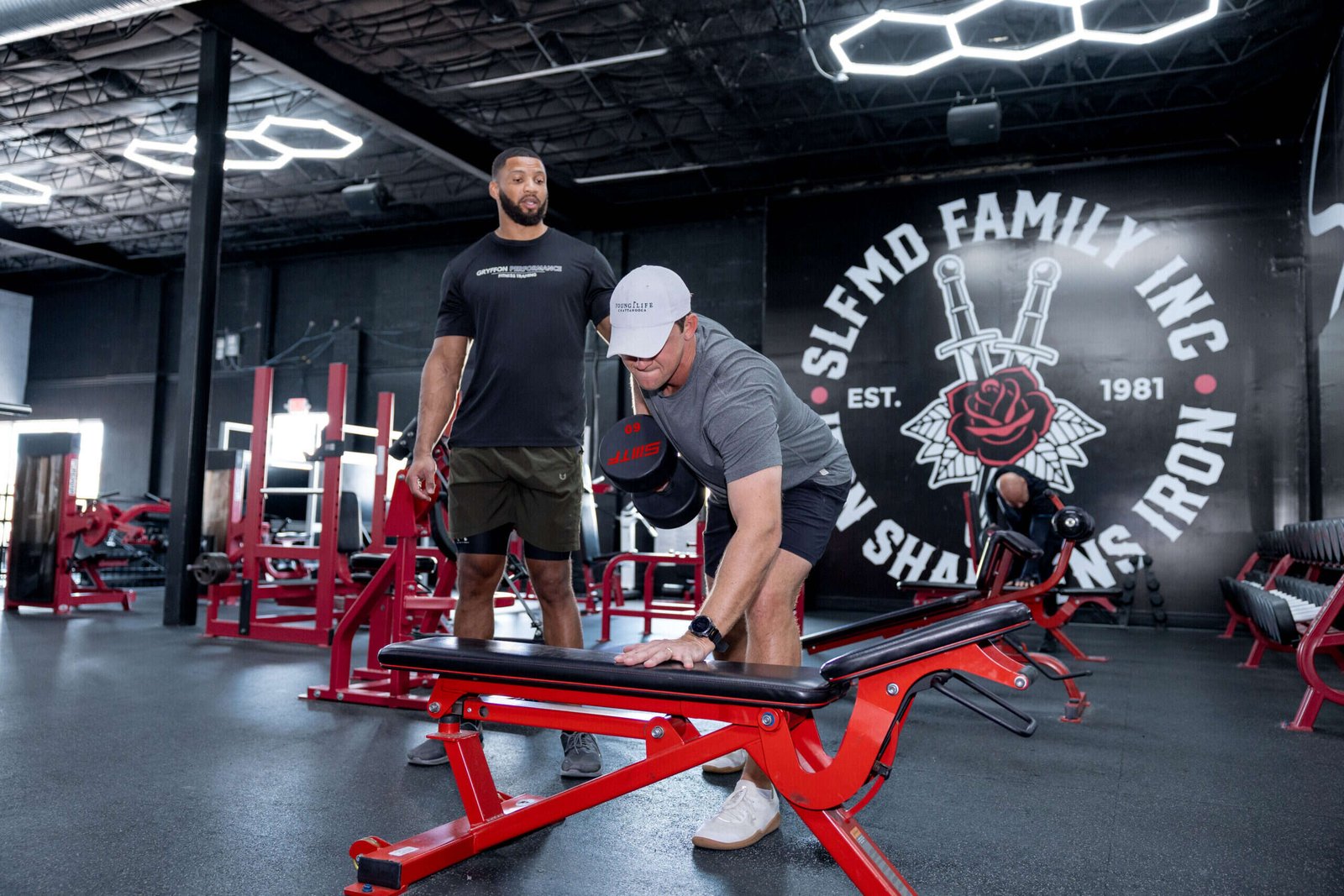
You can’t feel most of this. Your shoulder blade sits behind you, and a shrug that starts half a second early feels perfectly normal from the inside. From across the room, it’s obvious on the first rep.
What do a desk week and a travel week do to a shoulder?
Count the hours your arms spend reaching forward: laptop, steering wheel, phone, tray table. The front of the shoulder settles into that position while the upper back sits idle. Then on Saturday you ask it for a hard serve.
Travel stacks on top: bags into the overhead bin, a flat hotel pillow, short nights, a hotel gym with one rack of dumbbells. Carrying a toddler on one hip counts too. None of it is dramatic, but it all adds up, so a good coach asks about your week before picking a single exercise and has a plan for the heavy travel months, not just the quiet ones.
Can’t name what your shoulder is doing? Hardly anyone can, and it’s no reason to wait. David will see how the shoulder moves when you’re in the studio, and if what he finds calls for more than training, he has doctors he trusts to refer you to.
From the floor: Sore shoulders usually reach us after the lifts that mattered most are already gone, in our experience. Pressing goes first, then anything overhead, and then the upper body altogether. The shoulder doesn’t get better with that kind of rest. It just gets less used to doing anything.
If that sounds like your last year, apply for coaching and tell us which lifts you’ve dropped. We’ll start from what your shoulder handles today.
How does a coach build a sore shoulder back up?
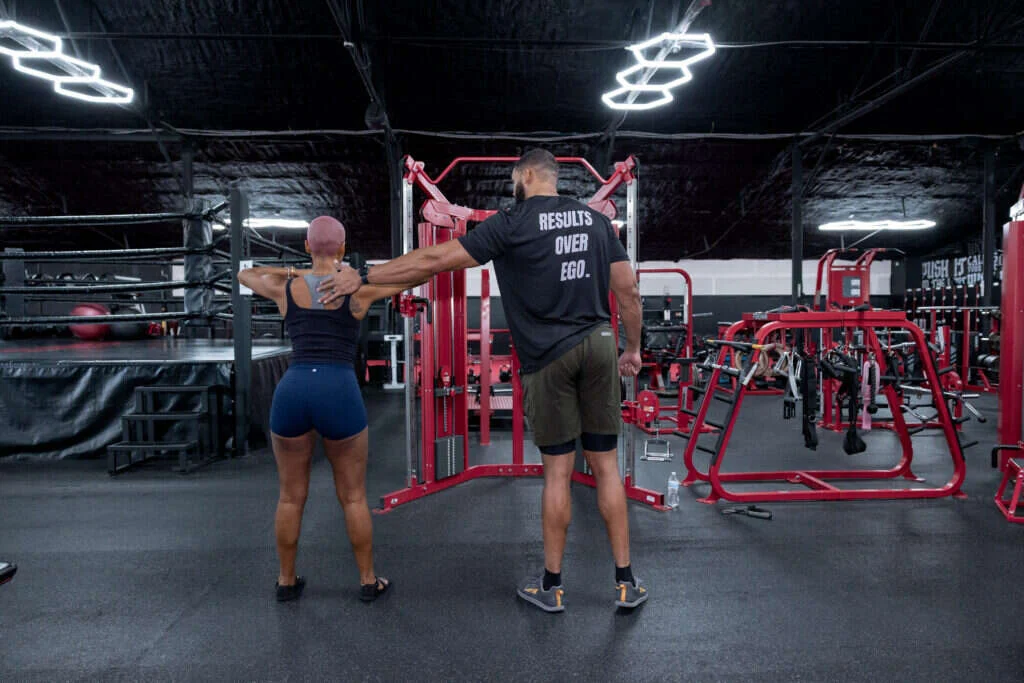
By watching before loading. Arms overhead against a wall. A hand reaching up your back. A plank, a row, a slow press with almost no weight. We’re checking where the shoulder blade goes, whether your ribs flare to fake the range, and whether one side moves differently from the other.
Then the lift that hurts gets swapped for one that keeps the pattern: a landmine press in place of an overhead press, a neutral grip in place of a straight bar. Load climbs when the shoulder feels fine the next morning, not just when the set felt easy. Progress is reaching overhead without the pinch, sleeping on that side again, and more weight pressed over months.
Red flags in any trainer: talk of fixing your shoulder or a guaranteed result by a date on the calendar, heavy pressing before anyone has watched you move, “push through it” as a strategy, or a trainer so careful that your shoulder does the same light band work for a year and never gets asked for more.
Where does physical therapy end and coaching begin?
Physical therapy is built to settle a painful shoulder and restore range, often right after an injury or surgery, and it has real value. In our experience the visits usually wrap up once the pain quiets down, well before the shoulder can handle a full week of lifting, travel and sport. The long stretch from “doesn’t hurt much” to “I don’t think about it” is months of progressive work, and that’s where a strength coach earns their keep.
Why a shoulder needs a coach for the long haul
Part of our job is keeping that shoulder out of trouble. A flare that costs you sleep and three weeks of training is expensive when you’re running a career and a household, so every exercise, angle and jump in load is picked to build strength without getting you hurt, and we change course the moment the shoulder pushes back.
You also stop carrying the planning. Which press, which grip, what to do on the day it’s cranky: we make those calls and explain them, so in time you know your own shoulder well enough to train it in a hotel gym without worrying. And because someone’s expecting you, the plan keeps moving through the busy quarter.
The goal is a lean, balanced body where the upper back, chest and shoulders share the work, so no single joint carries it.
It begins with a complimentary strategy session. David, our founder and head coach, sets aside about sixty minutes at the studio for it. Bring the movements your shoulder vetoes, your goals, training history and schedule. He’ll run a physical assessment, talk food with you and give you a tour. The hour ends with your first step and a plan that fits your real week.
David has coached men and women for 15-plus years. He’s been the injured one, too: a serious back injury, a comeback, and a 600-pound deadlift after it. He knows what it’s like to doubt part of your body under load.
A personal trainer for shoulder pain in Dallas
Gryffon Performance is a private training studio at 1925 E Levee St, Dallas, TX 75207, in the Dallas Design District, with free parking. We’re about 12 minutes from Highland Park and close to Uptown, Oak Lawn, the Medical District and Bluffview, and we coach people from the Park Cities and across Dallas. Get directions
50+ five-star Google reviews. Fifteen thousand square feet, private, built for coaching and nothing else. Every client gets a comprehensive assessment and personalized nutrition, included.
Apply for coaching and tell us what your shoulder has been saying no to. You’ll hear back within 24 hours, and your first session with us is a complimentary strategy session.
Related reading
- Strength Training and Shoulder Pain: What the Research Says
- Training With Joint Pain in Dallas: What Actually Helps
General information about training, not medical advice.