
You were an athlete once. College ball, a club team, a few years when you lifted with a purpose. Now it’s a full calendar, a deadlift you haven’t touched in years and a body that doesn’t move the way it did at 22. You start looking for help, and one website says “strength coach” while the next says “personal trainer.”
Does the difference matter?
The short answer: the title tells you where someone learned the job, not how well they do it. Strength coaches usually come from athletics. Personal trainers usually come from working with the public. Neither title is a license. What matters is whether they look at how you move, program load that progresses, handle your nutrition and adjust to your real week. If you want to be trained like an athlete on a schedule that fits a working life, apply for coaching and tell us what you used to be able to do. Your first session with us is a complimentary strategy session.
Key points
- “Strength coach” usually means a background in athletic performance: planned phases, strength, power, speed and conditioning.
- “Personal trainer” usually means a background with the public: individual goals, consistency and fitting training around a life.
- Neither title is a license, and the certifications behind both range from demanding to easy.
- The right person does both jobs: athlete-style programming for a body with a job, a family and some history.
What does a strength coach do?
The title comes from sport. Strength and conditioning coaches work in high schools, colleges and pro teams, getting athletes ready for a season. Their job is making people stronger, faster and harder to tire, and keeping them available to play.
The way they plan is worth knowing. They build training in phases that lead somewhere: a block to build muscle and work capacity, a block to get stronger, a block to turn that strength into power, then a lighter stretch before competition. Coaches call this periodization. In plain English, it means every month has a job, and the months add up.
That’s a real skill. The limit, in our experience, is that it was built for athletes whose lives revolve around training. A 45-year-old with a stiff back, two kids and a flight every other week needs the same science applied very differently.
What does a personal trainer do?
Personal trainers work with the public. Your goals, your history, your schedule. The good ones are excellent at the part sport coaches rarely have to think about: getting someone to show up consistently when nobody’s handing them a season, a scholarship or a roster spot.
The weakness sits at the low end of the field. Some trainers write workouts instead of programs. Every session is hard and different, you’re tired and sweaty, and three months later you’re no stronger, because nothing was built to progress.
Plenty of personal trainers program as well as any team coach. Plenty of strength coaches are great with people. The title alone won’t tell you which one you’re talking to.
Do certifications tell you who’s better?
Not much. A certificate shows someone passed a test once. On both sides, some credentials take serious study and some don’t, and none of them can show you how someone coaches a real person on a bad week.
Experience tells you more. Ask how long they’ve coached, who they’ve coached, and whether those people look like you: your age, your goals, your schedule, your old injuries.
What should you look for in either one?
These are the questions we’d put to any coach, and the ones we expect to be asked.
- Will you watch me move before you write a single set? In person. Years of sitting and old sport injuries leave habits you won’t feel, and someone has to spot them before the loading starts.
- Can you explain the plan? Why this exercise, why now and what comes next. If the answer is “we’ll see how you feel,” there’s no plan.
- How do you decide when to add weight, and when to back off? Progression is where most programs quietly fail. A coach should have a clear answer.
- Do you coach food too? For anyone who wants to look leaner, training without a food plan tends to fall short.
- What happens on a travel week? A real coach already has a shorter plan ready for it. Without one, the missed week gets blamed on you.
- What are we training toward? A heavy deadlift again, a golf season without paying for it on Monday, a lean, balanced body. Something you can name.
Anyone with a real process answers these without getting vague.
What if you already write your own program?
Then you’ll get more out of a coach than most. People who program for themselves usually know the exercises. What’s hard from the inside is seeing your own form, judging whether a load is too light or too heavy, and keeping the plan and the food adjusted when work gets busy. A coach handles that, and your energy goes into the training itself.
Competing in a sport with a team staff? Their plan leads in season. The off season is when we’d build the strength that carries you through the next one.
From the floor: In our experience, former athletes who come to us don’t miss the workouts. They miss having a plan with a point to it, and someone who’d tell them when a rep was off. A familiar story: someone pulls up their old college program, runs it at full speed, and within a month they’re sore, stalled or nursing something. The program wasn’t wrong. It was written for a 20-year-old whose only job was training.
If that rings true, apply for coaching and tell us where the old program broke down.
How we see the job
The way we see it, you shouldn’t have to choose. You want a strength coach’s programming, with phases, progressive load, power and conditioning that build on each other, and a personal trainer’s attention to you, your body and your week.
The hard part isn’t knowing that you need to get stronger. It’s getting the load, the progression and the food right for long enough, adjusted around a calendar that never cooperates, with someone who sees what you can’t. That’s the combination we coach, and keeping you out of injury while the weights climb is part of the job.
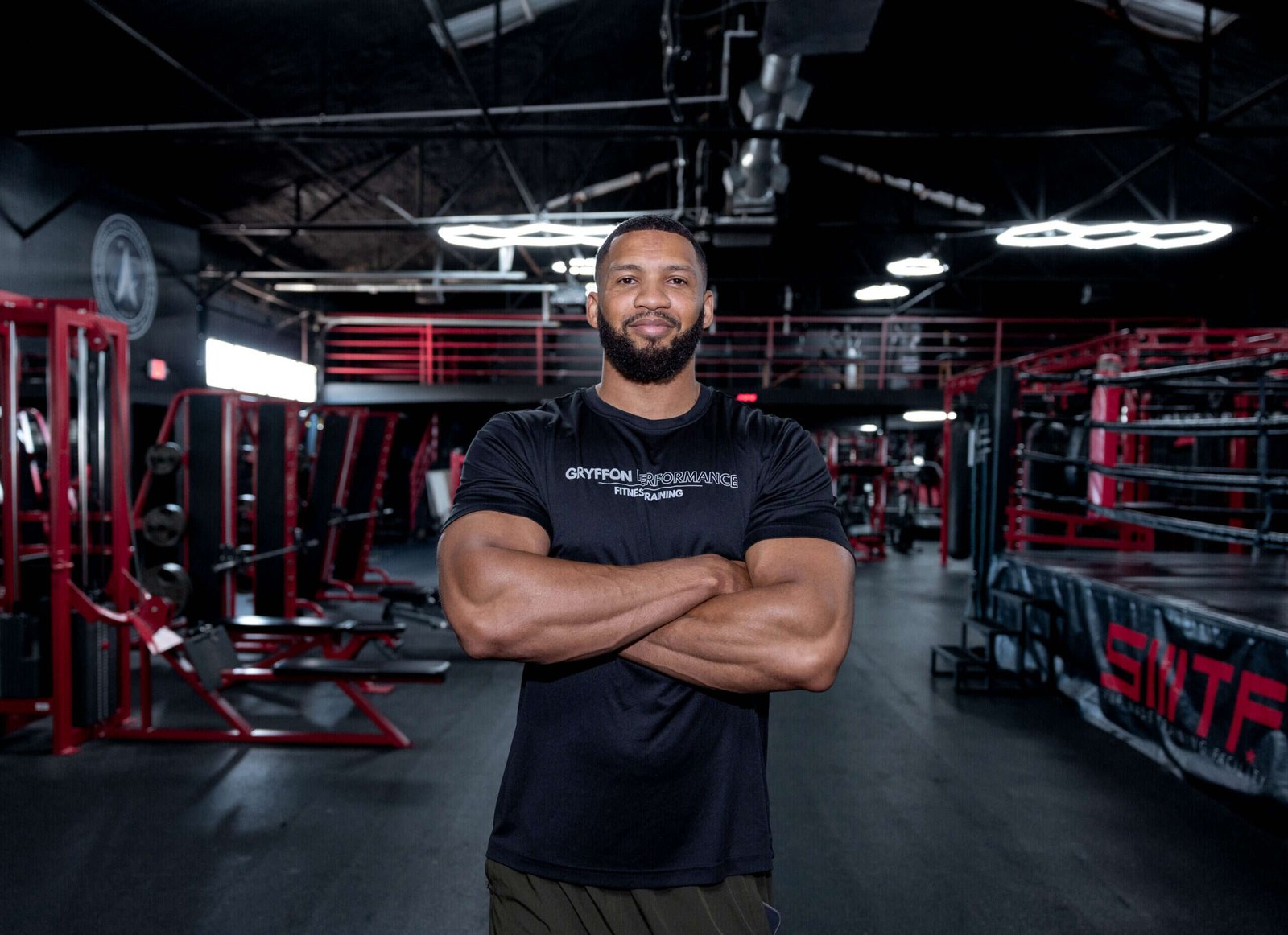
At Gryffon Performance, strength is the base, not the finish line. What we’re building is a lean, balanced body, so every training program includes personalized nutrition coaching.
The first meeting is a complimentary strategy session: 60 minutes with David, our founder and head coach, in person at the studio. He’ll ask about your goals, what you used to do, how your weeks run and anything that hurts, then take you through a physical assessment, a nutrition conversation and a tour. You walk out with a starting point, a schedule that fits your real week and a plan you understand.
David has coached for more than 15 years, and he’s been through the hard part: he came back from a serious back injury and has since deadlifted 600 pounds.
Not sure what shape you’re in after years away? Most people aren’t, so don’t let that stop you. In person, David looks at how you move, and when something calls for more than a coach, he knows the right doctors to send you to.
Strength coaching and personal training in Dallas
Gryffon Performance is a private training studio at 1925 E Levee St, Dallas, TX 75207, in the Dallas Design District, with free parking. We’re about 12 minutes from Highland Park and close to Uptown, Oak Lawn, the Medical District and Bluffview, and we coach people from the Park Cities and across Dallas. Get directions
50+ five-star Google reviews. Fifteen thousand square feet, private, built for coaching and nothing else. Every client gets a comprehensive assessment and personalized nutrition, included.
Apply for coaching and tell us what you want to get back. You’ll hear back within 24 hours, and your first session with us is a complimentary strategy session.
Related reading
- Athletic Performance Training in Dallas: Getting Capability Back
- How to Choose a Personal Trainer in Dallas
General information about training, not medical advice.