
You notice it on the office stairs. Then walking down from the parking garage after a client dinner. Then the morning after Saturday’s pickleball, when the first few steps out of bed feel like someone swapped your knee for an older one.
So you rest it: skip the run, sit out the league, wait. Maybe you do some physical therapy, it calms down, and the exercises fade once work gets busy. Then a weekend of matches brings it back.
The waiting is where the strength around that knee quietly goes.
The short version
For most nagging knee pain, what helps is progressive strength work: the quads, which control the knee, and the hips, which steer it. Load goes up gradually, over months. Rest and ice can take the edge off a bad few days. They don’t build anything.
Been working around a sore knee for months? Apply for coaching. Your first session with us is a complimentary strategy session.
One exception: a knee that’s red, hot and swollen with a fever, or one that won’t take any weight after a fall or a twist, needs a doctor today. That’s not a training problem.
How we think about it: load and capacity
Sport science looks at most nagging knee pain as a load problem. Your knee tolerates a certain amount of load right now. Stairs, a 5K, two hours of pickleball, a set of squats. Stay under that ceiling and it’s quiet. Go over it and it complains, often the next morning rather than in the moment.
Two things set that ceiling. One is how strong the muscles around the knee are. Your quads absorb force every time you go down a stair or land from a step, and your glutes and hips control where the knee travels when you squat, lunge or change direction. The other is how much total load you’ve been asking for lately. A knee that’s been doing very little doesn’t welcome a sudden weekend of three matches.
Resting lowers the pain for a while. It also lowers the ceiling, because muscle that isn’t challenged gets weaker. Progressive overload, adding load in small steps as your body adapts, is how the ceiling goes back up.
It’s a model, not a diagnosis. But it’s the most useful one we know for deciding what to do with a sore knee on a given day.
What the research says about knee strengthening exercises
Two studies carry most of the weight here.
Exercise helps, with honest limits. The 2024 Cochrane review pooled 139 trials and 12,468 adults with knee osteoarthritis and concluded that exercise probably improves pain and physical function in the short term. The same review rated the evidence low to moderate certainty and called the size of the benefit of uncertain clinical importance. So it isn’t magic. But unlike rest and ice, it leaves you with more capacity than you started with.
Train the hip, not just the knee. A 2018 meta-analysis of 14 studies in people with pain around the kneecap found that strengthening the hip and knee together reduced pain and improved activity more than strengthening the knee alone. The knee is where it hurts. Part of the answer sits above it. The pain relief showed up even without big measured strength gains, so consistent work matters more than a number on a test.
Those two studies cover different knees: arthritis in one, pain around the kneecap in the other. The training principle is the same, which is part of why we like it. Train the knee and the hip consistently, and keep at it over time.
What training looks like with knee pain
This is our approach, not a program. What you should do depends on your knee.
- Start with what the knee tolerates today. A squat to a higher box, a shorter step, a range that stays quiet. There’s almost always more available than people think. Finding that line yourself is tricky: too cautious and nothing builds, too ambitious and it flares the next morning.
- Build the quads. They do the braking on stairs, downhills and landings. A stronger quad gives the knee more support on every one of them.
- Build the hips. Glute and hip strength steer the knee through squats, lunges and cuts on the court. We train them hard regardless, because strong hips make almost everything easier. A knee drifting inward on a step-down feels normal from the inside. From the outside it’s easy to spot.
- Manage the whole week’s load. Running miles, matches, stairs and leg days all count. The way we see it, a knee rarely minds the work. It minds the sudden jump.
- Keep the engine running. Cycling and upper-body work hold your conditioning while the knee catches up.
- Let the next morning decide. If the knee is no worse the day after, the dose was fine and we nudge it up. If it’s clearly worse, we back off a step. Reading that response and adjusting the next session is a big part of what a coach does.
- Think in months. Strength takes weeks to start showing up and months to really change what a knee can handle. That’s long enough to doubt it’s working, which is exactly when someone tracking it matters.
None of this is secret. A video can show you a step-down. It can’t tell you whether today’s ache means push or back off, and it won’t change the plan when your knee starts talking again. The hard part isn’t knowing what to do. It’s doing it right, for long enough.
Stairs, runs and the pickleball court
We coach professionals, business owners and athletes from the Park Cities, Uptown, Bluffview and across Dallas. Their knees get asked for a strange mix. Hours bent at a desk or folded into an airplane seat, then a run on the Katy Trail, then a Saturday of tennis or pickleball.
Each of those asks something different. Stairs and downhill running load the quads as they lengthen under force. Tennis and pickleball add hard stops, lateral shuffles and quick changes of direction, which is a lot of braking for a knee that spent the week under a desk. And plenty of people feel a stiff, achy knee standing up after a long flight or a three-hour meeting.
That’s why we train for the life you actually have. If pickleball is the goal, the plan builds deceleration and lateral strength, not just leg extensions. If it’s running, we manage mileage alongside the strength work, so one doesn’t undercut the other.
The way we see it, every month you sit out and wait, the knee gets a little less ready for the thing you’re waiting to get back to.
If that sounds like your knee, apply for coaching and tell us what it’s been doing.
Getting back to squatting
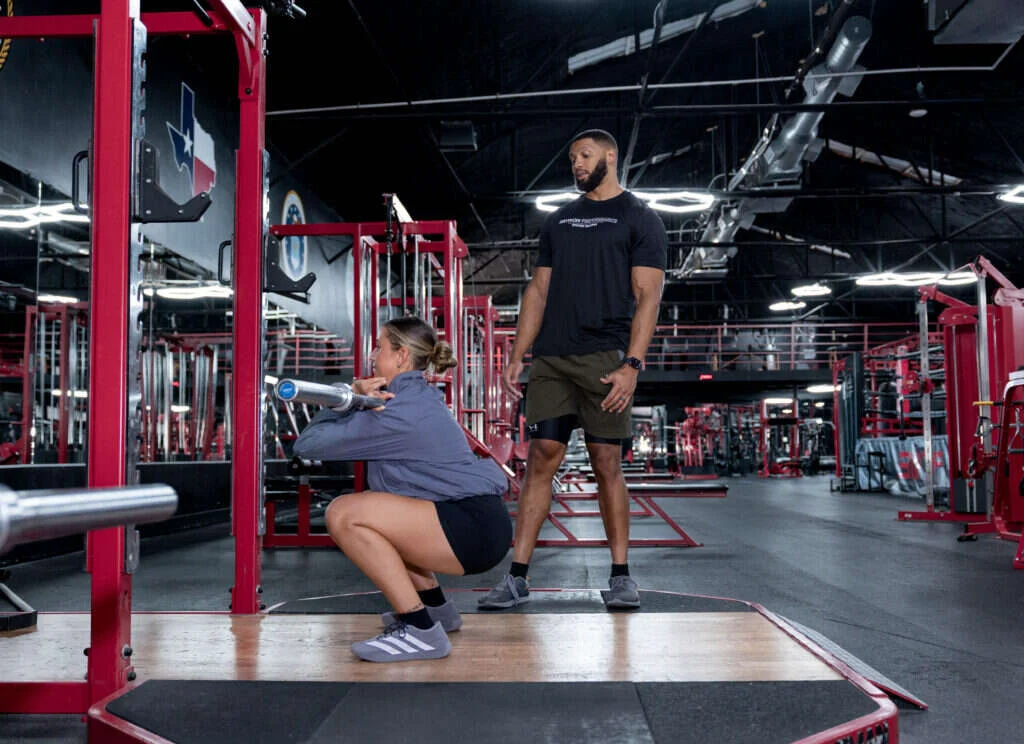
Plenty of people with a sore knee get told to stop squatting. We see it differently. A squat is just a loaded version of sitting down and standing up, which you’ll do thousands of times a year whether you train or not. Avoiding it doesn’t make the knee more ready for it.
Getting it back is a matter of range and load. Start at a depth and weight the knee is quiet with, then take it a little deeper or a little heavier as it holds up. It isn’t fast. But a knee that squats well tends to handle stairs, the car and the court a lot better too.
Why this needs a coach, not another appointment
You’ve done the rest, the ice and maybe the visits. What hasn’t happened yet is months of coached strength work. Treatment and training are different jobs. Physical therapy is built to calm things down and get you moving again, and that work often ends when the pain does. Building a knee that handles stairs, runs and a weekend of matches is the next job, and it takes months of progressive training from someone who coaches it for a living.
At Gryffon Performance we don’t just help you get strong. We train you toward a lean, balanced body, where your quads and hips carry the load and your knee stops taking the hit.
It starts with your complimentary strategy session: 60 minutes in person with David, our founder and head coach. Goals, training history, schedule, anything that hurts, a physical assessment, a nutrition conversation, and a tour of the studio. You leave with a starting point, a schedule built around your real week, and a plan you understand.
A knee that hurts going down stairs and a knee that aches after sitting are different starting points, and neither shows up on a questionnaire. Exercise choices and starting loads come out of that session, not out of a template. Personalized nutrition coaching is included in every training program, so the fuel and the recovery side get handled too.
Not sure exactly what’s going on with your knee? A lot of people aren’t, and that’s no reason to wait. David will look at how you move in person. If it turns out you need something beyond training, he knows the right doctors to send you to.
Training with knee pain in Dallas
Gryffon Performance is a private training studio in the Dallas Design District, at 1925 E Levee St, Dallas, TX 75207, with free parking. We’re about 12 minutes from Highland Park and close to Uptown, Oak Lawn, the Medical District and Bluffview, and we coach people from the Park Cities and across Dallas. 50+ five-star Google reviews. Fifteen thousand square feet, private, built for coaching and nothing else. Every client gets a comprehensive assessment and personalized nutrition, included. Get directions.
We see what you can’t from the inside, set the load for your knee and keep it climbing when your week gets busy. That’s the part that’s hard to do alone.
Apply for coaching and tell us what your knee has been doing and what you’ve already tried. You’ll hear back within 24 hours, and the strategy session is complimentary.
Related reading
- Training With Joint Pain in Dallas: What Actually Helps
- Getting Back to Training After an Injury
- Corrective Exercise: What Actually Helps, and What Doesn’t
- What a Fitness Assessment Should Actually Cover Before You Train
General information about training, not medical advice.
References
- Lawford BJ, Hall M, Hinman RS, et al. Exercise for osteoarthritis of the knee. Cochrane Database of Systematic Reviews, 2024. CD004376.pub4.
- Nascimento LR, Teixeira-Salmela LF, Souza RB, Resende RA. Hip and knee strengthening is more effective than knee strengthening alone for reducing pain and improving activity in individuals with patellofemoral pain: a systematic review with meta-analysis. Journal of Orthopaedic and Sports Physical Therapy, 2018;48(1):19-31.