
Three hours into back-to-back calls, you stand up and your lower back has set like concrete. You shift in the seat the whole drive up the Tollway, get on the floor at home, and pull your knees to your chest. It eases off. By Saturday it’s tight again, and you’re thinking about canceling the tee time.
Maybe you’ve done the physical therapy, felt better, and let the exercises slide once work got busy. Then it came back.
And every time that loop runs, the strength that would have changed it never gets built.
The short version
Lower back stretches do help, mostly with how well you move through the day. But stretching doesn’t raise how much load your back can take. If your back keeps going out, it needs to get stronger, not just looser. Keep the stretches. Add the strength.
Done with the loop? Apply for coaching. Your first session with us is a complimentary strategy session.
One exception: numbness around your groin or bottom, new trouble controlling your bladder or bowels, or weakness spreading into both legs means the ER, today. That’s not a training problem.
How we think about it: load and capacity
Sport science looks at most nagging back pain as a capacity problem. Your back, like every tissue in your body, tolerates a certain amount of load right now. Bending, lifting, three hours in a chair, carrying a sleeping kid in from the car. Stay under that ceiling and things are quiet. Go over it and your back lets you know.
Stretching changes how your back feels. It takes the edge off the tightness and buys you a few easier hours, and that’s real. What it doesn’t do much is raise the ceiling. Tissues adapt to the stress you put on them, and a gentle stretch doesn’t ask much of the muscles that hold your spine in position when you pick something heavy up.
Progressive overload does. Adding load in small steps, as your body adapts, is the most dependable tool we know for raising what a tissue tolerates. That’s the whole idea: find what your back handles today, and build from there.
It’s a model, not a diagnosis. But it’s the most useful one we know for deciding what to actually do on a given day.
Do lower back stretches actually help?
Yes, with a catch.
The strongest evidence we’ve got is a 2021 network meta-analysis that pulled together 217 randomized trials and 20,969 adults with chronic low back pain, and compared types of exercise against each other. Most types of exercise beat minimal treatment. Flexibility exercise, the bucket stretching falls into, helped with function: getting through the day and moving more easily. For pain, Pilates, McKenzie exercise and functional restoration came out ahead, and Pilates and McKenzie led for function too.
Notice what isn’t at the top: plain strength training, the thing a strength coach reaches for first. We’re telling you anyway. The authors’ practical advice was to do the exercise you enjoy, because the kind you keep doing beats the kind you quit.
The usual stretches, knee-to-chest, cat-cow, child’s pose and a gentle lying twist, are simple and easy to do daily. Move slowly, stay short of pain, and if one makes things worse, stop. If they make your mornings better, keep them.
The way we read the research, there’s no magic exercise for a back. There’s consistent exercise, done long enough to change something. Stretching counts. It’s just rarely enough on its own when your back goes out lifting a carry-on into the overhead bin.
What training looks like for a bad back
This is our approach, not a program. What you should do depends on your back.
- Keep the stretches that help. Treat them as a warm-up or a reset after a long drive, not the whole plan.
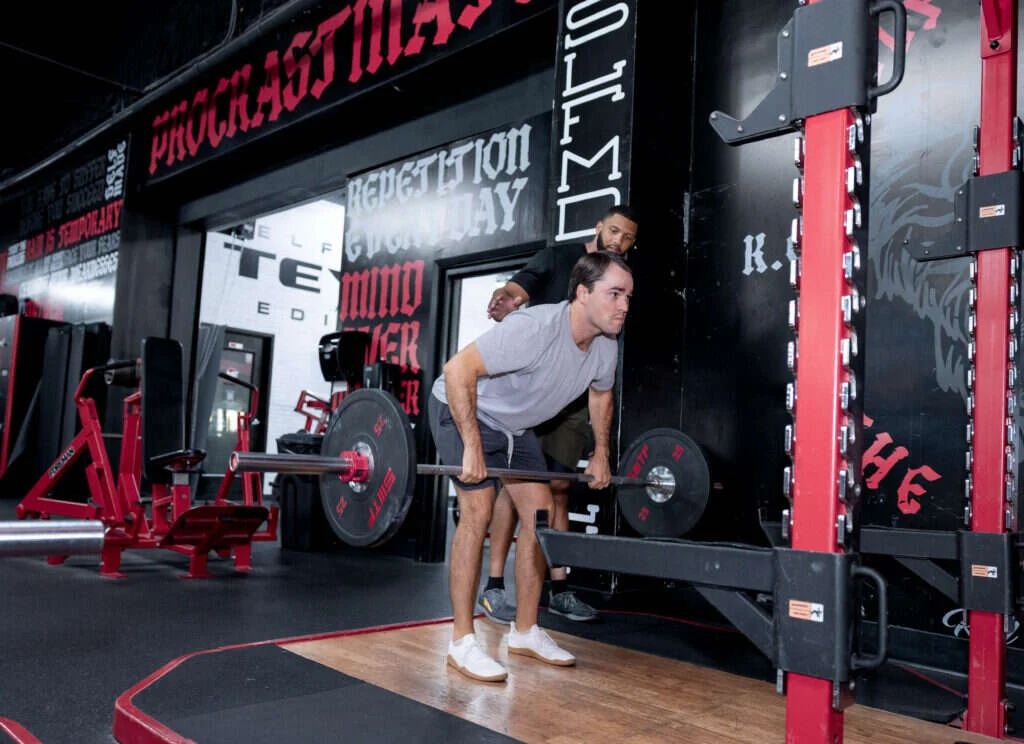
- Rebuild the hinge. Bending at the hips with your back in a strong position is how you pick up a golf bag, a kid or a barbell. After a bad back, a lot of people stop hinging and bend from everywhere else. We bring it back with light loads and clean positions before we chase weight. It’s also the hardest one to check yourself, because a poor hinge feels like a good one from the inside.
- Build a trunk that holds position. Not endless crunches. A trunk that resists bending and twisting while you carry, push, or grind through the end of a hard set.
- Train the hips hard. The way we see it, strong glutes and hamstrings let the hips do their share of a lift, so your lower back isn’t left holding the load.
- Let the next morning decide. If your back is no worse the day after, the dose was fine and we nudge it up. If it’s clearly worse, we back off a step. That response tells you more than how the session felt. Reading it week after week, and adjusting, is a big part of what we do.
- Think in months. Three good weeks, a flare-up, six weeks off and back to zero is the cycle that keeps backs fragile. Breaking it takes a plan that bends around travel weeks and deadlines instead of stopping for them.
None of this is secret. A video can show you a hinge. It can’t see your lower back take over on the last rep, and it won’t change the plan when your back starts talking again. The hard part isn’t knowing what to do. It’s doing it right, for long enough.
Desk days, long drives and the weekend round
We coach professionals, business owners and athletes from the Park Cities, Uptown, Bluffview and across Dallas. For a lot of them, the week looks the same: long stretches in a chair, a commute on Stemmons or the Tollway, a flight or two, client dinners, and training squeezed into whatever’s left.
Sitting alone isn’t the villain it’s made out to be. The problem is what that week leaves out. Your back adapts to what you do most, and if what you do most is sit, drive, fly and skip the session because the day ran long, the ceiling on what it handles drifts down. Then Saturday comes, and you ask it for 18 holes of rotation, a pickleball match, or a deadlift you used to pull easily.
Breaking up the day helps. Stand between calls, walk the terminal instead of sitting at the gate. But what changes the picture is training your back and hips to handle more than your week asks of them, so the weekend isn’t the hardest thing they do all month.
The way we see it, every month that pattern runs, your back’s margin gets a little thinner. The fix isn’t a gentler life. It’s more capacity.
If that’s your week, apply for coaching and tell us what your back has been doing.
Getting back to golf and heavy lifting
People with a bad back often get told to quit lifting. We see it differently. Lifting is where a lot of back capacity gets built, as long as the load matches what your back tolerates today and climbs from there.
The goal is specific: swing a driver without bracing for it, play a full tennis match, pick your kids up without thinking twice, pull from the floor again. That takes patience. The hinge and the trunk come back over months, and the heavy weights come last, not first. But it’s a reasonable goal, not a fantasy.
Why this needs a coach, not another appointment
You’ve done the stretches and maybe the visits. What hasn’t happened yet is months of coached strength work. Treatment and training are different jobs. Physical therapy is built to calm things down and get you moving again, and that work often ends when the pain does. Building a back with real capacity is the next job, and it takes months of progressive training from someone who coaches it for a living.
At Gryffon Performance we don’t just help you get strong. We train you toward a lean, balanced body, with hips and a trunk strong enough that your back stops carrying the load alone.
It starts with your complimentary strategy session: 60 minutes in person with David, our founder and head coach. Goals, training history, schedule, anything that hurts, a physical assessment, a nutrition conversation, and a tour of the studio. You leave with a starting point, a schedule built around your real week, and a plan you understand.
A back that tightens after two hours at a desk and a back that hurts every time you bend forward are different starting points. Exercise choices and starting loads come out of that session, not out of a template. Personalized nutrition coaching is included in every training program, because recovery and body composition are part of training, not separate from it.
David knows this one personally. He came back from a serious back injury and has since deadlifted 600 pounds.
Not sure exactly what’s going on with your back? A lot of people aren’t, and that’s no reason to wait. David will look at how you move in person. If it turns out you need something beyond training, he knows the right doctors to send you to.
Training for a bad back in Dallas
Gryffon Performance is a private training studio at 1925 E Levee St, Dallas, TX 75207, in the Dallas Design District, and there’s free parking. It’s about 12 minutes from Highland Park and close to Uptown, Oak Lawn, the Medical District and Bluffview, and we coach people from the Park Cities and across Dallas. Get directions. 50+ five-star Google reviews. Fifteen thousand square feet, private, built for coaching and nothing else. Every client gets a comprehensive assessment and personalized nutrition, included.
We see what you can’t from the inside, set the right dose and keep it going when your week gets busy. That’s the part that’s hard to do alone.
Apply for coaching before the next flare-up decides your week for you. You’ll hear back within 24 hours, and the strategy session is complimentary.
Related reading
- Your Desk Job Isn’t Wrecking Your Posture. It’s Something Else.
- Training With Joint Pain in Dallas: What Actually Helps
- Getting Back to Training After an Injury
- Personal training in Dallas
General information about training, not medical advice.
References
- Hayden JA, Ellis J, Ogilvie R, et al. Some types of exercise are more effective than others in people with chronic low back pain: a network meta-analysis. Journal of Physiotherapy, 2021;67(4):252-262. doi:10.1016/j.jphys.2021.09.004