
You used to hit it farther. Not dramatically, but you notice it on the same holes every weekend: a club more into the green than a few years ago, a drive that doesn’t quite reach the spot it used to. And after a long week at a desk, the first few holes feel stiff, and your lower back has an opinion by the back nine.
You’ve tried the usual answers. Stretching on the range, a new driver, a lesson or two.
The short answer: golf strength training works on the body behind the swing. Strong legs and hips, a trunk that can rotate and resist rotation, and the power to move fast. It won’t rebuild your swing. That’s your golf pro’s job. It gives your swing more to work with. If golf is a big part of your life and your body is falling behind it, apply for coaching and tell us about your game. Your first session with us is a complimentary strategy session.
Key points
- A 2020 review of 25 studies found that strength and conditioning often improved clubhead speed, ball speed and distance.
- Where it worked, the average gains were 4 to 6.4 percent.
- Strength and power tracked with clubhead speed. Flexibility on its own barely did.
- Training supports the swing. It doesn’t replace coaching from your golf pro.
What does the golf swing actually ask of your body?
A good swing looks effortless, but it’s one of the fastest things most adults ever ask their body to do. Force starts in the ground. Your legs push, your hips turn, your trunk passes that rotation up the chain, and the arms and club deliver it. In sport science that’s called the kinetic chain: each link hands energy to the next.
That means the parts of you that matter most aren’t the ones people usually train for golf. It’s less about the arms and more about:
- Legs that push into the ground. Squat and hinge strength is where a lot of the force begins.
- Hips that rotate both ways. The trail hip loads on the backswing. The lead hip has to turn and brake on the way through.
- An upper back that turns. If it doesn’t, something else has to.
- A trunk that’s strong, not just flexible. It has to rotate hard, and also stop rotation, thousands of times a season.
What does the research say about golf strength training?
More than you might expect. A 2020 systematic review in the Journal of Sports Sciences found 25 studies that compared golfers who did a strength and conditioning program with golfers who didn’t, or who trained differently. Most used some mix of strength training, plyometrics, stretching or core work, and many found a benefit. When the significant results were pooled, average increases in clubhead speed, ball speed and distance were 4 to 6.4 percent. A few studies also found changes in swing mechanics, accuracy or consistency.
A second review by the same researcher looked at which physical qualities go with clubhead speed. Upper body power, lower body strength, upper body strength and lower body power all had moderate correlations with it. Squat strength, jump power and medicine ball throws had some of the largest. Flexibility had a trivial correlation, though the author noted that might come down to how flexibility was measured.
Correlation isn’t proof, and results vary from person to person. But the direction is clear enough to act on: stretching on its own probably isn’t where your lost distance is hiding. Strength and power are worth training.
Why does golf hurt your back?
The way we see it, the lower back often takes rotation that should come from somewhere else. The lumbar spine isn’t built for a lot of twisting. The hips and upper back are. When a week at a desk leaves your hips stiff and your upper back rounded, the swing still has to happen, and the lower back gets asked to do more than its share.
Add in a cart ride where you sit between shots, a cold first tee and no warm-up, and it’s no surprise the back complains by the back nine. In our experience, getting the hips and upper back moving and strong takes a lot of pressure off. We’d build capacity there before chasing more speed. Keeping your back out of trouble for a full season is part of our job.
What we’d train for a golfer
Think of this as how we’d approach it, not a program to copy. The details depend on your body and your game.
- Start with how you rotate. Can you turn your hips both ways? Rotate your upper back without your lower back doing it? Stand on one leg and stay steady? A coach sees in minutes what you’d never notice from inside a swing.
- Build the base. Squats, hinges, split stance work and carries, loaded progressively over months. This is the force you’ll eventually turn into speed.
- Train rotation, and resisting it. Cable and medicine ball work that turns, and work that holds still against a pull. Both matter for a swing.
- Add power once you’ve earned it. Jumps and throws, done fast and fresh. Getting the dose right is the tricky part: too much and you’re tired for Saturday’s round, too little and nothing changes.
- Fit it around your season. Dallas golf runs most of the year, so the plan has to bend around tournaments, trips and a heavy week of rounds.
- Handle conditioning and food. Walking 18 holes in a Texas summer is real work. Nutrition coaching is included, so energy and body composition get managed alongside the training.
None of these exercises are secret. What’s hard is choosing the right ones for your body, setting the load, and knowing when to push and when your back needs a lighter week, without a coach watching every rep.
From the floor: In our experience, the golfers who come to us have usually tried to fix their body with their swing. New grip, new driver, new move. What’s often missing is the strength and rotation to make the swing they already have feel easy again.
If that’s your game right now, apply for coaching and tell us what’s changed in your game. We’ll start with how you move.
Do casual golfers need strength training too?
Yes. A few rounds a year means going from a desk chair to a full swing with nothing in between, and in our experience that’s when backs and shoulders start to complain. Strength in your legs, hips and trunk makes the swing you already have easier on your body, round after round.
Your pro and your coach do different jobs. Your pro works on the slice and the short game. We build the body that can swing the way your pro is teaching, without the tweaks that come from copying a tour player’s workout.
How we coach golfers
We don’t touch your swing. We build the athlete behind it: stronger legs and hips, a trunk that turns and holds, power you can use. What we want for a golfer at Gryffon Performance is a lean, balanced body that handles a full season and still feels good on Monday.
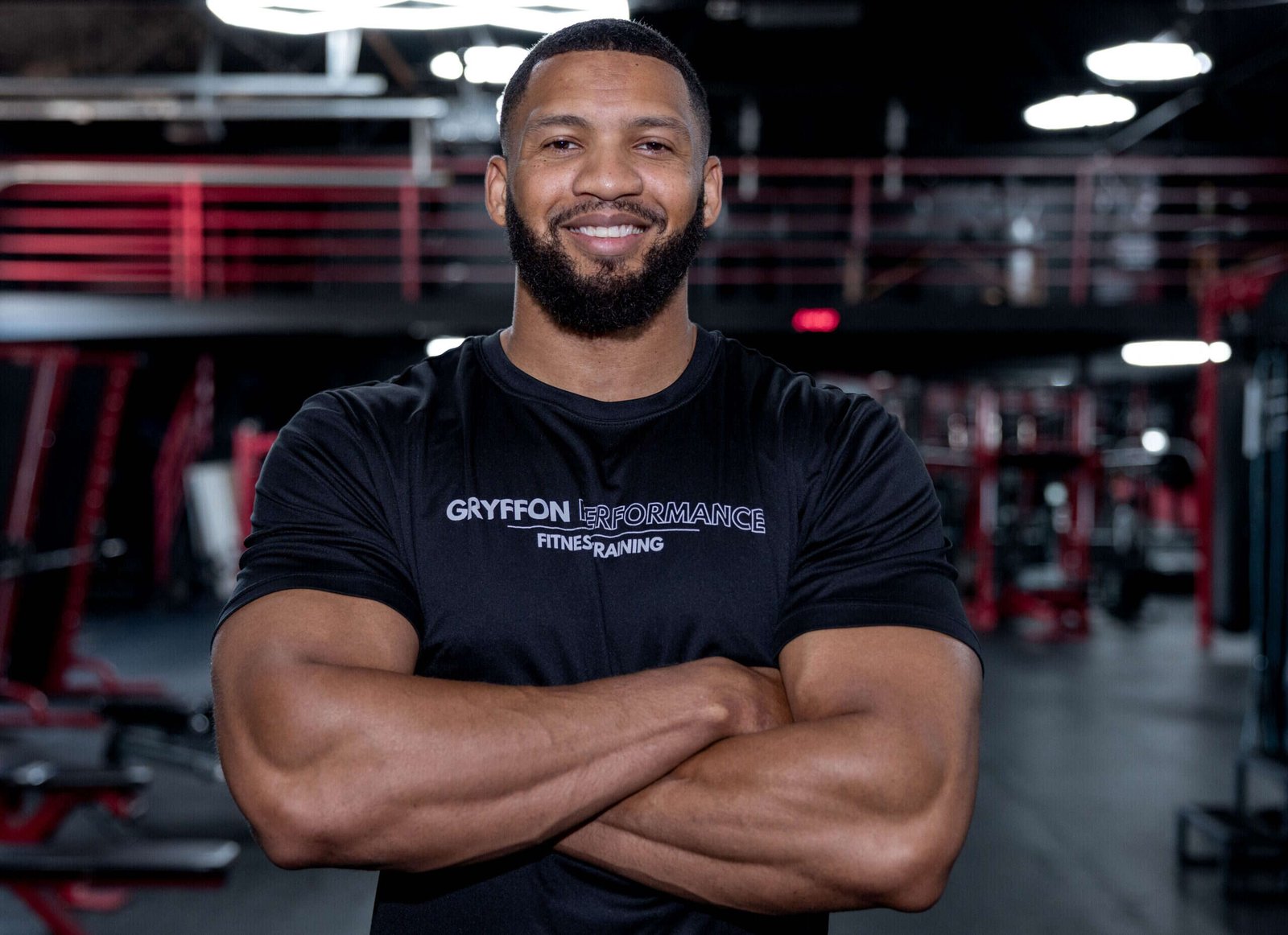
It begins with a complimentary strategy session: an hour at the studio with David, our founder and head coach. Bring your handicap, your schedule and whatever aches after a round. He’ll cover your goals and training history, put you through a physical assessment, talk nutrition and show you around. You’ll head out with a starting point, a plan you understand and training that fits around your tee times as well as your workweek.
David came back from a serious back injury and has since deadlifted 600 pounds, so a golfer’s lower back is never an afterthought here. He’s been coaching for more than 15 years.
Golf strength training in Dallas
Gryffon Performance is a private training studio at 1925 E Levee St, Dallas, TX 75207, in the Dallas Design District, with free parking. We’re about 12 minutes from Highland Park and close to Uptown, Oak Lawn, the Medical District and Bluffview, and we coach people from the Park Cities and across Dallas. Get directions
50+ five-star Google reviews. Fifteen thousand square feet, private, built for coaching and nothing else. Every client gets a comprehensive assessment and personalized nutrition, included.
Apply for coaching and tell us what you want back in your game. You’ll hear back within 24 hours, and your first session with us is a complimentary strategy session.
Related reading
- Athletic Performance Training in Dallas: Getting Capability Back
- Lower Back Stretches vs Strength: What Actually Helps a Bad Back
General information about training, not medical advice.
References
- Ehlert A. The effects of strength and conditioning interventions on golf performance: a systematic review. Journal of Sports Sciences, 2020;38(23):2720-2731. doi:10.1080/02640414.2020.1796470. PMID 32723013.
- Ehlert A. The correlations between physical attributes and golf clubhead speed: a systematic review with quantitative analyses. European Journal of Sport Science, 2021;21(10):1351-1363. doi:10.1080/17461391.2020.1829081. PMID 32981467.