
You’ve got the calendar open and a number in your head. Five days a week, because that’s what the guy at the office who’s always in shape does. Or once, because that’s all the room your week seems to have between the commute and the kids’ practices.
You’ve tried the big number before. Five days lasted right up until the first week with a trip in it. Then it was two, then none, then a fresh start the following month.
The short answer: at Gryffon Performance, we recommend at least three strength training days a week. Three is our minimum: enough practice on the lifts and enough weekly work to keep progressing, with each day kept manageable. Above it, your goal and recovery decide the rest. If you want help making three days stick, apply for coaching and walk us through a normal week. Your first session with us is a complimentary strategy session.
Key points
- At Gryffon Performance, we recommend at least three strength training days a week. That’s our minimum for steady progress.
- A 2016 meta-analysis of 10 studies found that training a muscle twice a week built more of it than training it once a week.
- The three-day minimum is our coaching recommendation built on that research, not a study result.
- Above three, extra days only help if you recover from them, and a coach adjusts your number as your goals and calendar change.
What does the research say about training frequency?
A 2016 meta-analysis by Schoenfeld and colleagues pulled together 10 studies that compared how often people trained. Higher frequencies were linked to more muscle growth, with an average effect of 0.49 against 0.30 for lower frequencies. In the studies that matched the total amount of work, training each muscle twice a week beat training it once.
The authors’ conclusion was that the major muscles should be trained at least twice a week to maximize growth. Whether three times beats two is still an open question.
So the research shows that training more often helps. It doesn’t hand you a number. Our three-day minimum is a coaching recommendation built on that finding, not something the study itself tested.
Why do we recommend at least three strength days?
- More practice on the lifts. A squat, a hinge, a press and a row are skills as much as exercises. Rehearse them three times a week and the pattern holds, so you spend your time adding weight instead of finding the groove again.
- Enough weekly work to keep progressing. Getting stronger means the work has to keep climbing week after week. Three days give it somewhere to go.
- Room to spread the load. Split across three days, no single day has to carry everything. Each one stays manageable, your sets stay sharp, and you recover in between.
- Consistency. Three days becomes a rhythm your week is built around. Lose one to a late meeting and you’ve still trained twice.
Why isn’t once or twice a week enough?
Once a week beats nothing. It’s also a hard way to make steady progress.
In our experience, a single weekly session ends up doing too many jobs. You spend the first part of it re-learning movements you did seven days ago. You’re sore every time, because your body never gets used to the work. And with only one shot at each lift, it’s tough to push the weight up week after week.
Add one missed week and you’ve gone two weeks without training. That’s how plenty of people end up feeling like they’re always starting over.
Two days is a real step up, and the research backs that. But each day then carries half your week, and one missed day cuts your training in half.
Is more always better?
No. Above three, extra days help only if you can recover from them and keep them up.
Your body gets stronger between sessions, not during them. Training is the stress. Recovery is when the adaptation happens. Stack five or six hard days on top of short sleep, a demanding job and a flight or two, and the recovery side of that equation gets squeezed. In our experience, that’s when progress flattens, joints start talking and motivation drops.
There’s a practical cost too. Six days a week means six workouts to plan, six slots to protect, and six chances for life to get in the way. That’s a lot to carry next to a career and a family.
What should you do on the other days?
The days between strength sessions still matter. They’re just lighter.
- Walk. Daily steps add up, help with recovery and do more for fat loss than most people expect.
- Sleep. It’s where a lot of the adaptation happens, and it’s usually the first thing a busy week takes.
- Eat enough protein. Muscle needs the raw material to rebuild after training.
- Move the parts that sit all day. A short walk at lunch or a few minutes of easy movement after a long drive.
These all happen outside the studio, which is exactly why they slip. Part of a coach’s job is noticing when they have and changing the plan around it.
How do you pick the right number for you?
Three is the floor. Deciding what to build on top of it is where most people get stuck, because the right answer moves. It depends on what you’re after: strength, muscle, fat loss, getting back to a sport. It depends on how long you’ve trained, how your joints feel, how you’re sleeping and what the next month of your calendar holds.
That’s a lot to weigh every few weeks on your own, on top of everything else. It’s also easy to get wrong. Pile on days your body can’t absorb and something flares up, you lose two weeks, and the routine falls apart.
A coach handles that. We set the frequency, watch how you respond and change it when your goals or your week change. Keeping you out of injury is a big part of that. We add a day above three only when your body has shown it can recover from the ones you’re doing, so you get stronger without getting hurt.
From the floor: The biggest progress we see, in our experience, doesn’t come from whoever starts with the most days. It comes from the people still showing up in month nine. Quite often, that’s someone who started with three days instead of the five they had in mind, and added more once the habit held.
If you’ve been stuck between too ambitious and not enough, apply for coaching and tell us what you’ve tried.
How we set your training frequency
Knowing that training more often helps is the easy part. Keeping three strength days going for months, and deciding when to add more as work, travel or your body shifts, is where doing it by yourself usually breaks down.
Strong matters, but we’re after more: a lean, balanced body. So how often you train, how you eat and how you recover get planned as one thing, with personalized nutrition coaching built into every training program.
The way in is a complimentary strategy session. For one hour in person, David, our founder and head coach, asks about your goals, what training’s looked like over the years, your calendar and any pain. You’ll move through a physical assessment, talk food and see the floor. When it’s done, you’ll know your starting point, how your strength days fit your real week, and the reasoning behind the plan.
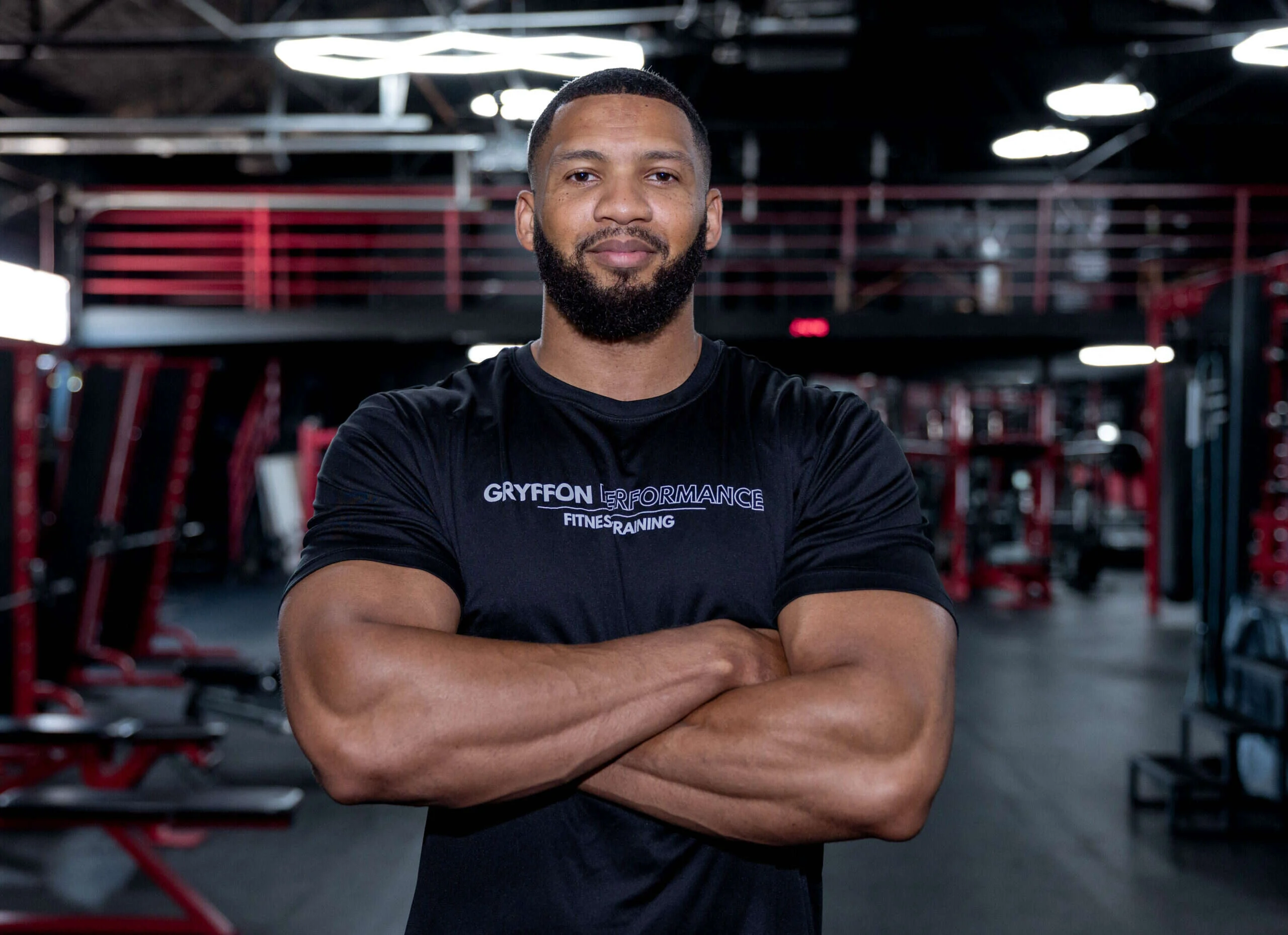
It’s a judgment call built on more than 15 years of coaching men and women. David has also had to rebuild after a serious back injury himself, and he went on to deadlift 600 pounds, so pacing the work isn’t theory to him.
Worried you’re not fit enough to start, or that an old injury will flare up? Those are reasons to begin with a coach, not reasons to hold off. David sees for himself how you move, and when an issue belongs with a doctor rather than a coach, he knows exactly who to send you to.
Personal training in Dallas, built around your week
Gryffon Performance is a private training studio at 1925 E Levee St, Dallas, TX 75207, in the Dallas Design District, with free parking. We’re about 12 minutes from Highland Park and close to Uptown, Oak Lawn, the Medical District and Bluffview, and we coach people from the Park Cities and across Dallas. Get directions
50+ five-star Google reviews. Fifteen thousand square feet, private, built for coaching and nothing else. Every client gets a comprehensive assessment and personalized nutrition, included.
Apply for coaching and tell us how many days you’ve been trying to fit in. You’ll hear back within 24 hours, and your first session with us is a complimentary strategy session.
Related reading
General information about training, not medical advice.
References
- Schoenfeld BJ, Ogborn D, Krieger JW. Effects of resistance training frequency on measures of muscle hypertrophy: a systematic review and meta-analysis. Sports Medicine, 2016;46(11):1689-1697. doi:10.1007/s40279-016-0543-8