
The flight’s booked. Four days in Colorado with the family over the holidays, or a long weekend in Utah with the friends you’ve skied with since college. Then you remember last year. Quads burning by the second run, legs gone by early afternoon, and that last run of the day where your form fell apart and you were mostly just hoping to get down.
Dallas doesn’t help. It’s flat, and the only moguls in town are the speed bumps in your parking garage.
The short answer: ski season training should build leg strength in the bent-knee positions skiing actually uses, then build the endurance to hold those positions turn after turn when you’re tired. Start eight to twelve weeks out if you can, and start now if you can’t. If you want your legs ready this year, apply for coaching and tell us when your trip is. Your first session with us is a complimentary strategy session.
Key points
- Skiing asks your legs to hold and absorb force while bent, for minutes at a time, so strength and strength endurance both matter.
- A model of a professional skier’s turns found the outside leg did the heaviest work, led by the glutes, the quads and the hamstrings.
- In a study on a giant slalom course, fatigue cut skiers’ knee extensor strength about 19 percent and made them slower and less effective.
- The training is simple to list and hard to dose, especially when the trip date doesn’t move and your work calendar does.
What does skiing actually ask of your legs?
A lot of skiing is your legs working while they’re bent and loaded. You hold a flexed position, absorb the snow coming up at you, and push into the outside ski to steer. That’s different from a gym squat you stand up out of in two seconds. It’s long stretches of tension, plenty of it in the lowering and holding phases.
A 2023 study by Heinrich and colleagues built a 3D musculoskeletal model from a professional skier’s turns. The outside leg carried the highest loads, and the main muscles doing the work were the gluteus maximus, the vastus lateralis (part of the quads) and the hamstrings. The knee stayed bent more than 60 degrees through the turn. It’s one skier and a model, not a trial, but it shows where the work lands: hips and thighs, in a deep, held position.
Why do your legs give out by the afternoon?
Fatigue doesn’t just make skiing feel worse. It changes how you ski. Chollet and colleagues had 12 skiers run a four-turn giant slalom section, once fresh and once after a fatiguing protocol. Afterward their maximal knee extensor strength had dropped about 19 percent. They took longer through the section, skied a longer line and applied force to the snow less effectively.
Translate that to a vacation. By the afternoon your quads have less to give, you sit back, your turns get sloppier and the mountain starts skiing you. The way we see it, a stronger, more fatigue-resistant pair of legs is what keeps your technique intact into the last runs, which are the runs people remember.
That’s the part we can build. Legs that still hold their position late in the day keep you in control when the snow gets choppy and the light goes flat.
Ski season training: what we’d build
These are principles, not a program. The details come from your legs, your history and how many weeks you have.
- A base of strength first. Squats, hinges, split squats and step-ups, loaded and built up over weeks. Stronger legs make every turn a smaller share of what you can do.
- Time under tension in skiing positions. Holds and slow lowering in a bent-knee position, because that’s where skiing lives. The burn you feel on the mountain should feel familiar, not new.
- Side-to-side strength. Lateral lunges and single-leg work, because the outside leg steers and the hips keep the knee lined up.
- Some quickness. Low jumps and fast changes of direction, kept controlled, so your legs can react when the snow changes under you.
- Conditioning that matches a run. Hard intervals of a minute or two with rest between, closer to a run and a chairlift than to a long jog.
- A taper before you fly. The last week before the trip is about arriving fresh, not squeezing in more. Plenty of people get this one backward.
Why is ski prep hard to get right on your own?
The list is the easy part. The dosing is where people get it wrong. Too little and you show up with the same legs as last year. Too much, too close to the trip, and you arrive sore and flat, or with a knee that started complaining two weeks ago. Getting the progression right inside a fixed deadline, while work keeps shifting your week, is a real piece of planning.
You also can’t see your own knees. On a single-leg squat or a lateral lunge, a knee drifting inward or a hip dropping feels normal from the inside. From a few feet away, it’s obvious in one rep, and it’s exactly the kind of pattern you don’t want to take onto a steep run.
Getting you to the mountain uninjured is part of our job. We choose every exercise, load and jump in difficulty so the prep builds you up instead of breaking something along the way. Losing three weeks to a tweaked back right before the trip is how a ski vacation turns into a week in the lodge.
An old knee or a cranky lower back usually isn’t a reason to skip the prep. Most of the time, the way we see it, those aches are the muscles around the joint lacking strength, and guessing your way around them tends to mean doing less or pushing through until it flares. Our job is to build that strength in increments the knee or back is happy with.
Then there’s food and recovery. Ski days burn a lot, and the days before them matter. Your training program comes with personalized nutrition coaching, so you’re fueled for the trip and not undoing your progress over the holidays.
From the floor: In our experience, the skiers who come to us before a trip rarely lack fitness in general. What’s missing is strength in that low, held position, and it shows the first time we ask them to hold a split squat for longer than feels polite.
If your trip is on the calendar, apply for coaching and tell us how last season ended for your legs.
Is it too late to start before this season?
Not if you start soon. More weeks give you more room to build, but even a shorter runway is better than flying out with nothing. The real cost of waiting is another trip spent managing your legs instead of enjoying the mountain, and a spring where you swear you’ll start earlier next year.
Ski season is a good excuse, but we’re training more than your quads. What Gryffon Performance is after is a lean, balanced body, one ready for a mountain in February and a desk the rest of the year.
Begin with a complimentary strategy session. That’s a full hour with our founder and head coach, David, at the studio. Tell him where you’re skiing and when, how you train now, your goals and anything that bothers you on the slopes. Once he’s assessed how you move, talked through food with you and shown you the floor, you’ll know where your legs are starting, how training fits around work and what the weeks between now and the trip look like.
Rebuilding strength on a deadline is familiar ground for David. In 15-plus years he’s coached men and women through it, and he rebuilt his own strength after a serious back injury, eventually deadlifting 600 pounds.
Not sure your knees are up for it? Better to find out now than halfway down a blue run. David watches you move before anything gets loaded, and if your knee turns out to need more than training, he knows the doctors to send you to.
Ski season strength training in Dallas
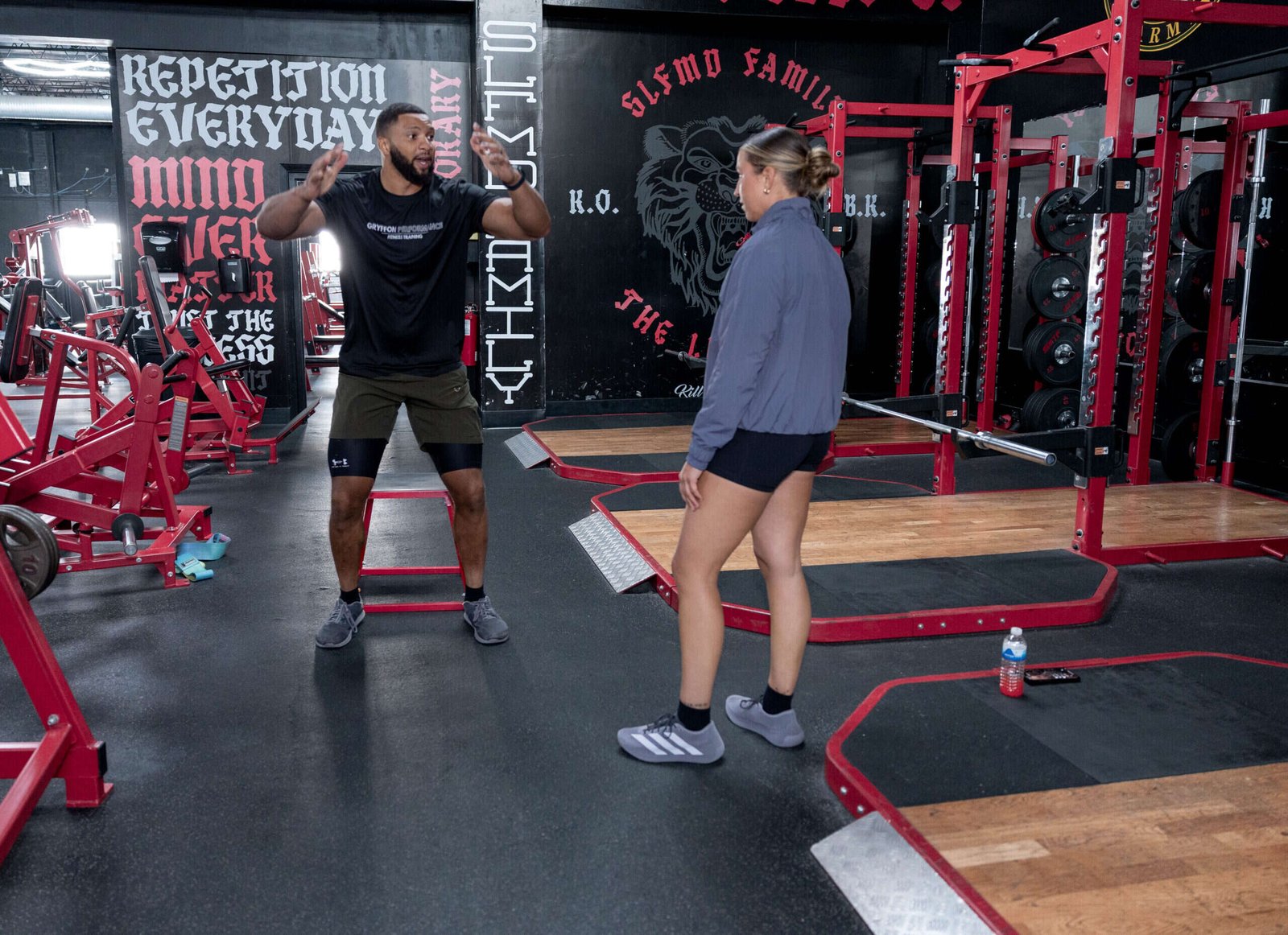
Gryffon Performance is a private training studio at 1925 E Levee St, Dallas, TX 75207, in the Dallas Design District, with free parking. We’re about 12 minutes from Highland Park and close to Uptown, Oak Lawn, the Medical District and Bluffview, and we coach people from the Park Cities and across Dallas. Get directions
50+ five-star Google reviews. Fifteen thousand square feet, private, built for coaching and nothing else. Every client gets a comprehensive assessment and personalized nutrition, included.
Apply for coaching and tell us where you’re skiing this year. You’ll hear back within 24 hours, and your first session with us is a complimentary strategy session.
Related reading
- Athletic Performance Training in Dallas: Getting Capability Back
- Strength Training and Knee Pain: What the Research Says
General information about training, not medical advice.
References
- Heinrich D, van den Bogert AJ, Mössner M, Nachbauer W. Model-based estimation of muscle and ACL forces during turning maneuvers in alpine skiing. Scientific Reports, 2023;13(1):9026. doi:10.1038/s41598-023-35775-4. PMID 37270655.
- Chollet M, Hintzy F, Cross MR, et al. Fatigue-induced alterations in force production, trajectory and performance in alpine skiing. Journal of Sports Sciences, 2024;42(20):1904-1915. doi:10.1080/02640414.2024.2414362. PMID 39466112.