
You finally hired someone. First day, they hand you a workout. It feels like progress, because somebody’s finally telling you what to do. Three weeks in, your shoulder’s grumbling, the plan doesn’t fit a week full of travel and late nights at the office, and the scale hasn’t moved.
It’s the same cycle as training on your own, just with someone else writing the guess. It works for a few weeks. Then work gets busy and you’re back at square one.
The direct answer: before anyone programs a single set, a good assessment should look at your goals, your training history, how you move in person, what hurts, the real shape of your week, and your nutrition. Anything less is a template.
If you want to start with one done properly, apply for coaching. Your first session with us is a complimentary strategy session.
Why the starting point decides everything
The strongest argument for assessing before prescribing comes from research on how differently people respond to the exact same training.
Hubal and colleagues put 585 people through an identical 12-week resistance training program for the arm and measured what happened. Strength gains ranged from zero to roughly 250 percent. Muscle size changes ran from slight losses to substantial growth. Same program, same duration, same supervision, wildly different outcomes.
Bouchard and Rankinen had already documented the same pattern in endurance training. In large samples of inactive people on standardized programs, gains in aerobic fitness ranged from almost nothing to 100 percent.
Here’s why that matters. Training works by stress and adaptation. Give the body a load it can just handle, let it recover, and it adapts. Too little and nothing changes. Too much and you flare up, stall or quit. The right dose depends on where you’re starting, and you can’t find that by guessing.
So a template isn’t a plan. It’s a bet on you being average, and that data says people vary far too much to bet on it.
What a good starting process should look at
You don’t need to know a coach’s methodology to judge their starting process. You just need to know what they asked about before they decided anything.
What you’re actually trying to achieve. Not “get in shape.” Leaner, stronger, back to tennis or pickleball, able to carry your kid up the stairs without your back arguing. These lead to different training.
Training history. What you’ve done, what worked, what you quit and why. Someone who lifted seriously for six years and stopped is in a completely different position from someone who’s never trained, even if today’s numbers look similar.
Current ability. What your body can do right now, observed in person rather than self-reported on a form. In our experience, people are bad at describing their own movement. You can’t see your own compensations, and from the inside they feel normal.
Pain and joint concerns. The shoulder from 2019. The knee that complains on stairs. The lower back that flares after a flight. In our experience, these are among the most common reasons people stop training, and they’re the thing nobody asks about properly. They’re a reason to train smarter, not a reason to wait.
The actual shape of your week. Not how often you’d like to train. How often you’ll realistically make it in a bad month. A plan built for your ideal week is a plan that fails in a normal one.
Sleep, stress and travel. These change what your body can recover from, which changes what should be programmed. Ignoring them isn’t rigor. It’s incomplete information.
Nutrition, if body composition is part of the goal. You can train well for a year and see almost nothing change in the mirror if nutrition is left entirely to you. And the targets aren’t set once. They need adjusting as your weight, training and appetite change.
Why one assessment isn’t enough
An assessment is a starting point, not a verdict. Your body changes as you train. That’s the point. The plan that fit in week one is often out of date by week eight if nobody adjusts it.
This is where people on their own tend to stall. They keep running the plan that worked in month one, same loads, same movements, long after the body has adapted. Progressive overload only works if someone keeps reading the response and deciding what comes next. Knowing when to push and when to back off, week to week, is the hard part, and it’s very hard to judge about yourself.
The red flags
A six-question form and a program in your inbox. Intake forms are for scheduling. They’re not an assessment.
Nobody watches you move. If the whole process happened over text, nobody has seen the thing they’re prescribing for.
Nobody asks what hurts. Or worse, they ask and then don’t change anything.
Same first month for everybody. Ask directly what a different client would be doing in week one. If the answer is vague, you already have your answer.
A guaranteed number by a guaranteed date. Nobody can honestly promise that. Someone who does is telling you they’re comfortable saying things that aren’t true.
What an assessment isn’t
The fitness industry oversells this constantly, so we’ll be blunt. A training assessment isn’t a medical exam, and a coach shouldn’t pretend it is. It won’t put a label on why your back hurts, and it can’t promise you’ll never get hurt.
What it does is narrower and more useful for training. It finds an appropriate starting point, accounts for what you can do today and what’s limiting you, and takes most of the guesswork out of the first two months.
Not sure exactly what’s going on? That’s normal, and it’s no reason to wait. David will look at how you move in person. If it turns out you need something beyond training, he knows the right doctors to send you to.
What to ask before you commit
Whoever you’re considering, in Dallas or anywhere else, ask these three and listen to how long the answers take:
What happens before I train for the first time, and how long does it take?
How would my first month differ from someone else’s, and what specifically drives that difference?
What happens when something hurts, or when my schedule breaks for two weeks?
Depth of answer is the signal. Anyone who’s built a real process can talk about it for ten minutes without effort. Anyone who hasn’t will get vague fast.
Why this works better with a coach
In our experience, the hard part isn’t knowing what to do. It’s doing it right, for long enough, with someone who sees what you can’t. That’s the job of an experienced coach, and it’s ours. At Gryffon Performance we don’t just help you get strong. We train you toward a lean, balanced body.
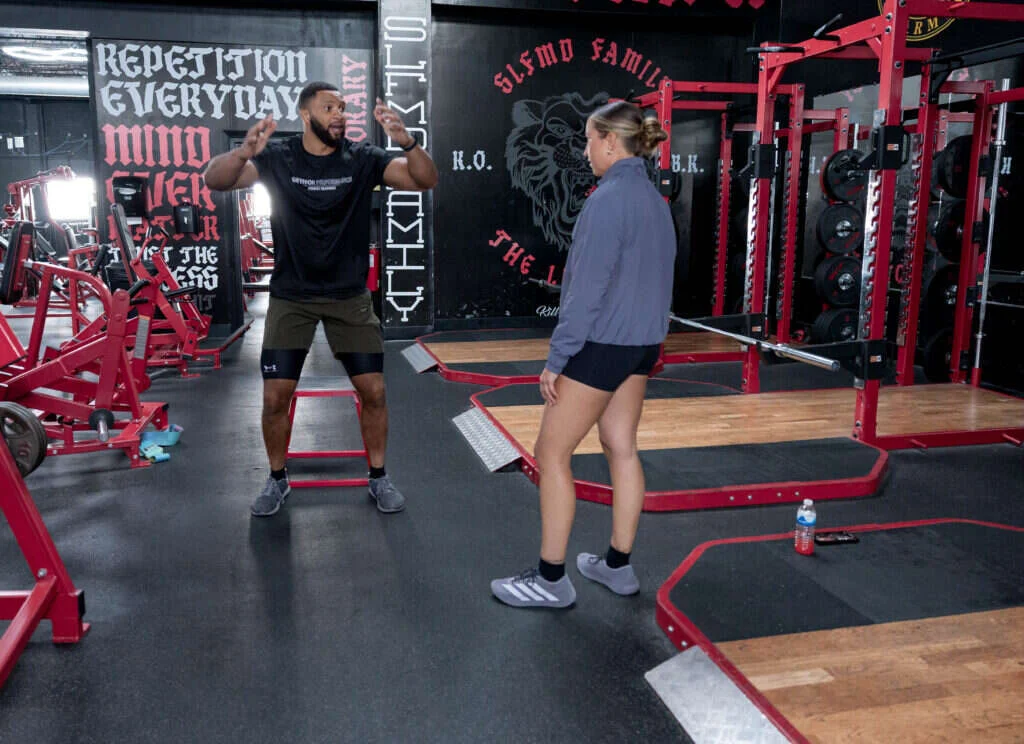
Every client starts with a complimentary strategy session before any training begins: 60 minutes in person with David, our founder and head coach, who has more than 15 years of training and coaching experience. Goals, training history, schedule, anything that hurts, a physical assessment, a nutrition conversation and a tour of the studio. You leave with a clear starting point, a schedule built around your real week, and a plan you understand.
The assessment is where we earn our results. It’s how we build a plan for your body instead of for the average of 585 people, and we keep adjusting it as you change. Personalized nutrition coaching, including calorie and macro coaching, is included in every training program and moves with you too. If you’ve been handed a program on day one before and it went nowhere, apply for coaching and start from the right place.
Personal training in the Dallas Design District
Gryffon Performance is a private training studio at 1925 E Levee St, Dallas, TX 75207, in the Dallas Design District. 50+ five-star Google reviews. Fifteen thousand square feet, private, built for coaching and nothing else. Every client gets a comprehensive assessment and personalized nutrition, included. We’re about 12 minutes from Highland Park and close to Uptown, Oak Lawn, the Medical District and Bluffview, and we coach professionals, business owners and athletes from the Park Cities and across Dallas. There’s free parking. Get directions.
See what clients have said, then apply for coaching and we’ll start with your goals and where you’re starting from.
Related reading
- Personal training in Dallas
- Nutrition coaching in Dallas
- Private Training Studio vs Public Gym: What Actually Changes
- Training here from Highland Park and the Park Cities
- Training here from Uptown and Turtle Creek
- Strength Training and Lower Back Pain: What the Research Says
References
- Hubal MJ, Gordish-Dressman H, Thompson PD, et al. Variability in muscle size and strength gain after unilateral resistance training. Medicine and Science in Sports and Exercise, 2005;37(6):964-972.
- Bouchard C, Rankinen T. Individual differences in response to regular physical activity. Medicine and Science in Sports and Exercise, 2001;33(6 Suppl):S446-S451. doi:10.1097/00005768-200106001-00013
General information about training, not medical advice.